The Ceremony
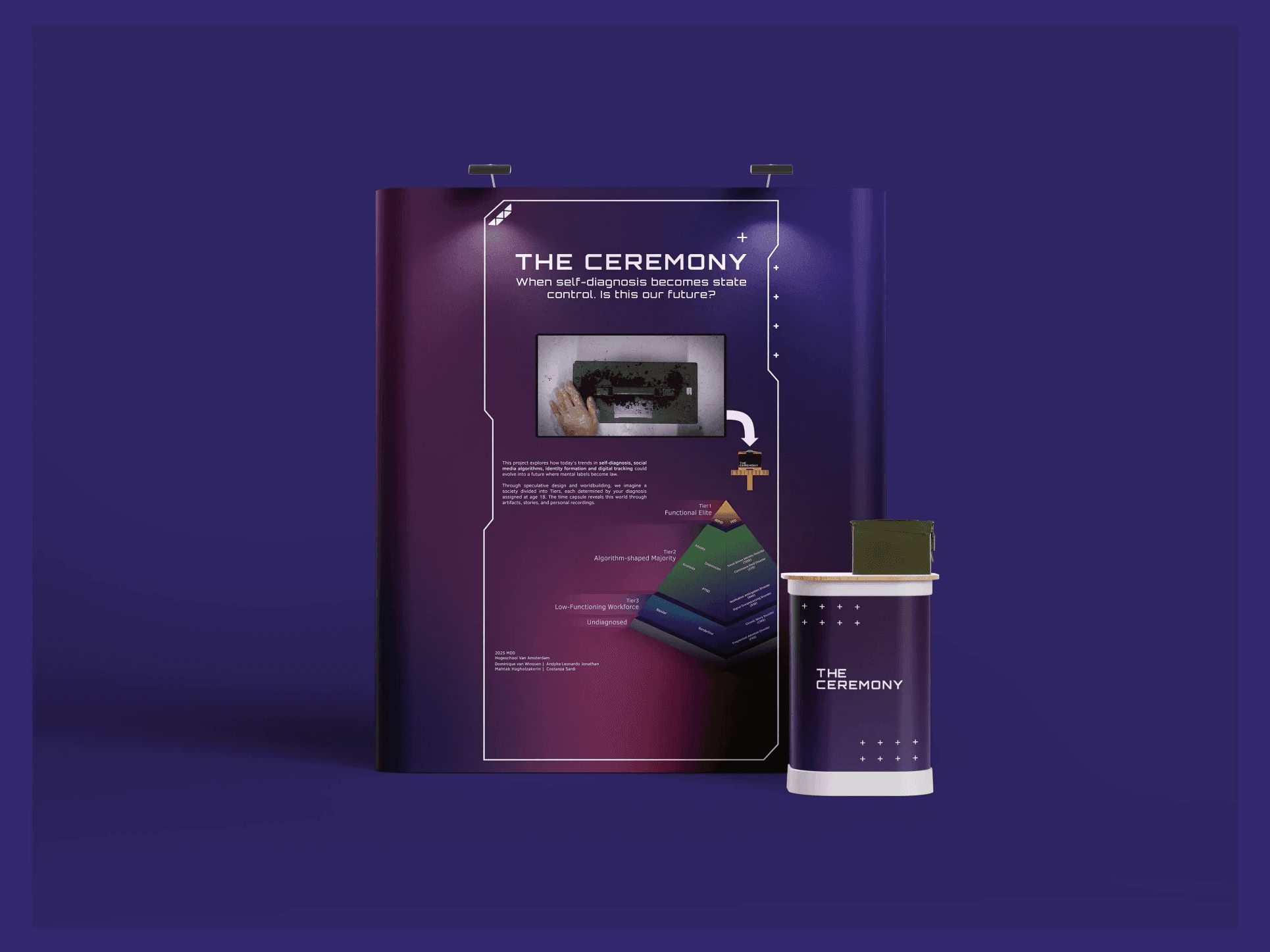
The Ceremony explores how classification systems influence behavior, roles, and interactions within a society. Inspired by real and fictional hierarchies, such as China’s social credit system and dystopian narratives (Divergent, The Hunger Games), the project translates abstract social systems into tangible experiences. Users interact with objects, prototypes, and environments to explore how rules, roles, and feedback affect engagement and understanding.
project type
Speculative Design
role
UX Designer
timeline
8 Weeks
team
Graphic Designer
Interactive Designer
Problem and goal
Algorithms often narrow information exposure, shaping what people see and know. Aiming to increase people, mainly adolescence's awareness regarding this matter, we design an experience that broadens perspectives and invites reflection on these unseen effects.
Speculative design
Speculative design encourages critical reflection on the current situation by exploring possible future scenarios. Using this approach, we aim to immerse participants in future scenarios, provoking them to consider the long-term impact of today’s decisions through “what if?” experiences.
To understand what defines effective speculative design and its guiding principles, we conducted research through literature reviews, precedent studies, as well as expert and user interviews. The key lessons were:
Explore futures, not just problems. Prioritize on stimulating reflection and discussion
Storytelling, narratives, artifacts, or scenarios are key tools
Reference trends, technologies, or behaviors that exist today to make the scenario believable
🌎 World building
Key activities in this stage:
Created a fictional world integrating social, political, historical, and character elements, shaping how the story unfolds
Crafted immersive narrative elements using familiar scenarios to reduce cognitive load and make abstract systems tangible
Designed a structured classification system, enabling users to quickly understand roles, hierarchies, and interactions
Research and exploration
To design the world’s logic, we looked at both real and fictional systems that use classification to organize society. These included China’s social credit system, as well as the social hierarchies portrayed in Divergent and The Hunger Games film.
All these systems share a key idea: they sort people into categories that shape their roles, opportunities, and influence within the world.
Key finding
Design Action
Familiar scenario aid comprehension. Audiences understand systems faster when they recognize references
Implement familiar structures to reduce cognitive load
Clear mechanisms, rules, and consequences help audiences anticipate outcomes
Implement visible rules and privileges to reduce confusion
Storytelling and narrative context makes abstract concepts relatable
Integrate a system logic within stories to make the abstract concepts tangible and memorable
The result

The New Normal of 2104
This is a world where society is divided into tiers, where having a mental disorder makes you “better,” and where a person’s happiness, wealth, and quality of life are determined by these factors. When a person turns eighteen, they receive an invitation from the government to attend “The Ceremony,” an event in which they are assigned a diagnosis based on how the algorithm sees their life.

✏️ Diegetic Prototypes and Concept Testing
Key activities in this stage:
Created futuristic everyday objects diegetic prototypes that is familiar enough to recognize, yet speculative enough to provoke curiosity that represents the speculative world.
User testing combined world-building and prototype exploration through focus group:
Participants explored scenarios and interpreted the system’s logic.
Feedback revealed how users experienced interactions and the immersive environment.
Iterated prototypes based on insights to enhance comprehension and engagement.
The initial design

Testing and result
We tested prototypes with a focus group to evaluate whether participants could understand the world and system. Observations focused on curiosity, hesitation, and interactions.
Key findings and the implication for design:
Material exploration
Insight
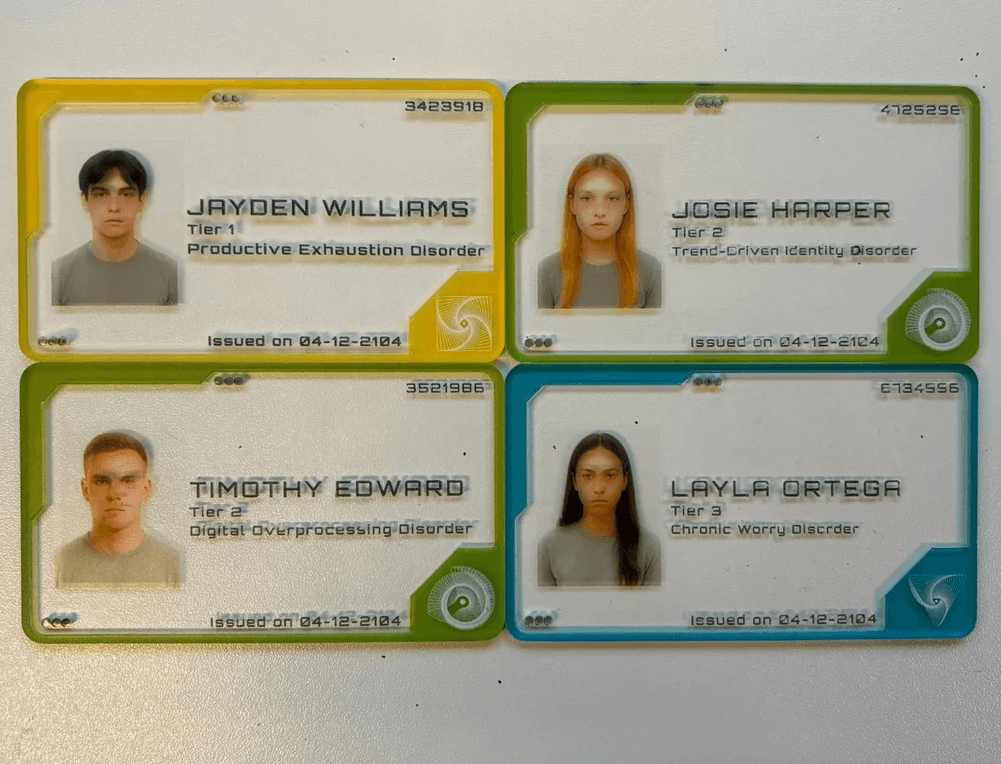
Using older or outdated materials made the futuristic world feel less believable.
Design action
Tested different materials for diegetic prototypes and switched from paper to transparent PVC sheets, which enhanced the futuristic mood and strengthened the concept’s believability.
Information Hierarchy
Insight
The initial prototypes were too text-heavy and lacked visual cues, causing audiences to skip large portions of the content.
Design action
Focused on visuals on certain prototypes by reducing text-based information and emphasizing key titles with large supporting images to create clear and scannable content.


Bridge prototype to set expectation
Insight
The wide range of prototype options confused audiences and made it hard to understand the core concept.
Design action
Created a bridge prototype that audiences see first, providing an overview of the world and helping them grasp the system before exploring further.
The result


⚙️ The Setup
Key activities in this stage:
Designed the setup to present the concept’s scenario and showcase supporting prototypes
Observed audience interaction with the setup, paying attention to curiosity, hesitation, and the questions they asked
Iterated the setup based on observations to improve comprehension and engagement
The initial designs
The main challenge in developing the setup was keeping audiences informed and helping them understand the concept without causing cognitive overload. Audiences tended to jump between sections, skipping key parts of the experience. To address this, we explored direct and indirect guides to help users navigate and stay oriented within the world.
Setup A
Setup B


Testing and iteration
We tested the setup and observed audiences’ interactions, focusing on curiosity, hesitation, and the questions they asked. Insights from these observations guided improvements to enhance comprehension and engagement.
Key finding
Design Action
Too much information was presented at once, leading to cognitive overload
Reduced the number of sections and focused the experience on a clear entry point (hook) and the key prototypes
Participants often focused on only one section because there were no clear connections between sections
Implemented interactive navigation elements to guide participants between sections and maintain engagement
The bridge prototype effectively provided context, helping participants understand the world more quickly
Refined the bridge prototype into a central hook and integrated it with the navigation interaction to guide the overall experience
Participants explored freely and tended to engage first with the prototype that caught their attention
Reduced the number of displayed prototypes and prioritized the most visually engaging ones based on observation results
The final result


This project strengthened my ability to translate complex concepts into clear user experiences. By observing how participants interacted with the prototypes and setup, I learned how structure, visual cues, and interaction design can guide users through information while reducing cognitive overload.